Highlights
- Context-aware unattended luggage detection using AI: Built and deployed an AI-powered unattended luggage detection system on KABAM’s autonomous surveillance robots. The system combines persistent object tracking with a defined observation window to accurately identify genuinely abandoned items while minimizing false alerts in crowded public spaces.
- Real-time video analytics on constrained hardware: Designed a high-performance edge AI inference pipeline capable of processing multiple camera feeds and running parallel safety analytics modules in real time without compromising latency or operational reliability.
- Data-driven computer vision engineering for production environments: Curated a domain-specific training dataset using open datasets and robot-captured footage, significantly improving detection accuracy under occlusion, high crowd density, and real-world environmental noise.
Ensuring public safety demands systems that can react quickly and reliably, our team is proud to work with KABAM Robotics, a leading Singapore-based company specializing in AI-powered security robots under their Smart+ platform. One of our key contributions is a robust unattended luggage detection module, built for deployment on KABAM’s surveillance robots in Singapore. This blog outlines what we built, how it works, and the key technical lessons learned.
Background
Technology has long played a crucial role in public safety, starting with the simple yet tireless CCTV camera. For decades, these cameras formed the backbone of security operations, continuously recording activity across public spaces. However, traditional surveillance was inherently reactive. Human operators were required to monitor multiple live feeds, and incidents were often reviewed only after they occurred. These systems provided visibility, but not understanding.
This paradigm has shifted with advances in artificial intelligence and computer vision. Modern security systems are evolving from passive recording tools into proactive, real-time intelligence systems. Cameras are no longer just sensors that capture footage. They now interpret scenes, recognize patterns, and support faster, more informed decision-making.
At KABAM Robotics, this shift is foundational to how autonomy is designed. As intelligence architects, we focus on shaping the cognitive layer behind autonomous surveillance robots, enabling them to interpret complex environments proactively. Building safe and reliable autonomy requires balancing hardware endurance, software intelligence, and operational responsibility. This principle underpins every system we design.
Unveiling the robot’s mind
It is a weekday evening at a busy MRT interchange in Singapore. Commuters move steadily through the station. Near one of the pillars, a backpack is left behind. Its owner is no longer nearby.
Unattended items are always treated with caution. Security teams are expected to respond quickly, while avoiding unnecessary disruption. The challenge lies in determining whether an object has truly been abandoned or is only momentarily unattended. This is where KABAM’s autonomous surveillance robot plays a key role.
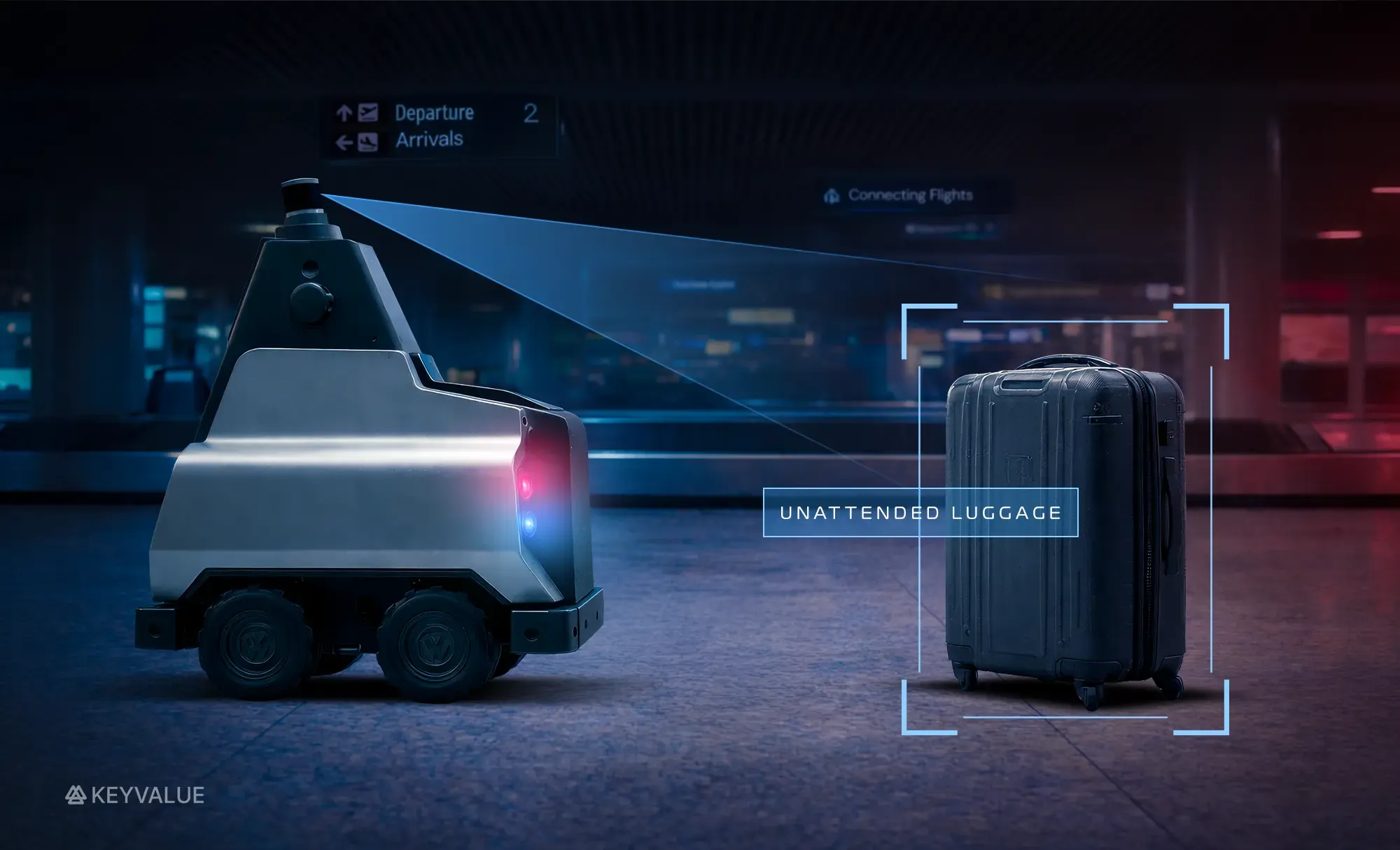
As the robot navigates the environment, its onboard cameras continuously capture live video. These feeds are processed by the AI intelligence layer we built into the system. When the backpack enters the frame, it is identified as luggage and monitored as the surrounding activity unfolds.
The system observes whether any individual remains associated with the object, even as people move through the scene or temporarily obstruct the view. Rather than triggering an immediate alert, the robot applies a defined observation window to confirm whether the item remains unattended.
If the luggage stays stationary and no human association is detected beyond this threshold, the system escalates the event. An alert is sent to security personnel, including relevant context such as location and visual evidence, enabling a confident, measured response.
What could otherwise lead to confusion or panic is handled in a controlled and systematic manner. The robot augments human operators with clear, actionable intelligence instead of raw video streams.
Behind this behavior is a real-time video analytics pipeline that operates entirely on the robot’s edge computing hardware. Live video streams are processed to detect luggage items such as backpacks, handbags, and suitcases, while a tracking layer maintains object identity across frames.
To support this, we evaluated multiple real-time object detection architectures, including YOLO, DETR, and EfficientDet, to identify a model that offered the right balance between accuracy and inference speed in crowded public environments. The selected approach was then fine-tuned using a carefully curated dataset tailored to luggage-related scenarios.
All components operate in parallel as part of an inference pipeline, allowing multiple safety modules, such as unattended luggage, fire detection, and trash monitoring, to run concurrently without compromising real-time performance.
Designing this pipeline was not simply a matter of model selection. Real-world constraints, limited data availability, and strict performance requirements significantly influenced both the system architecture and the training strategy.
Challenges & solutions
Building a system capable of analysing live video streams and delivering accurate results in real time introduced challenges that went well beyond initial design expectations. During discussions with our AI engineers, few issues consistently stood out.
“A big hurdle was the lack of sufficient, relevant data for this specific use case. Without a strong dataset, accuracy suffered. We had to build a high-quality dataset from scratch while also ensuring the system could process feeds from two cameras simultaneously. That combination forced us to rethink performance optimization at every level.”
- AI engineer, KeyValue
Rather than relying on a single open dataset, we combined and refined data from established sources such as OpenImages V7 and COCO (Common Objects in Context) datasets. More importantly, we incorporated footage captured directly from the robots themselves. This ensured the training data closely reflected real-world operating conditions.
Annotation efforts focused on highly specific scenarios, such as bags carried in hand or worn on shoulders, rather than generic object images. This deliberate filtering significantly improved real-world detection accuracy.
These design decisions enabled the system to mature into a production-ready solution, tightly integrated with KABAM’s autonomous robots. Several core capabilities were critical to this outcome.
Robust object tracking
The system maintains persistent object identity until an item exits the camera’s field of view, even during partial occlusion. This persistence is essential for determining whether luggage is genuinely unattended.
Intelligent false positive reduction
A defined three-minute observation rule ensures that objects are not flagged prematurely. This approach minimizes false alerts and builds trust among security operators.
The inference architecture allows multiple detection modules to run independently and concurrently. This prevents performance degradation and ensures alerts are routed only to their relevant endpoints.
Optimized real-time communication
Both on-device processing and cloud communication were optimized to achieve low latency and high reliability. Once an alert is triggered, it reaches operators and dashboards almost immediately, supporting rapid response.
Outcomes
Beyond delivering a production-grade system, the project offered valuable insights into deploying AI in real-world security environments.
While the importance of data is well understood in theory, this project highlighted the level of effort required to curate high-quality datasets for niche, real-time use cases. When suitable data does not exist, it must be carefully created, validated, and refined.
Equally important was the realization that trust is built through precision and restraint. Effective security systems must balance vigilance with contextual awareness to avoid unnecessary disruption.
Finally, deploying AI outside controlled lab conditions introduced hardware and operational complexities that demanded creative problem-solving. Addressing these challenges strengthened both the system and the team behind it.
The result is an AI-driven intelligence layer that enhances KABAM’s surveillance robots with practical, reliable situational awareness. The journey was demanding, but it delivered a solution that reflects the realities of public safety operations and the rigor required to support them.
FAQs
1. What is unattended luggage detection?
Unattended luggage detection is a computer vision–based security capability that identifies bags, backpacks, or suitcases left stationary without an associated person for a defined period. In public safety and surveillance applications, this helps security teams detect potential risks without relying on constant manual monitoring.
2. Why is unattended luggage detection challenging in real-world public spaces?
Real-world environments are highly dynamic. People move unpredictably, objects are frequently occluded, and crowded scenes can temporarily block visibility. Accurate unattended object detection requires persistent tracking over time and contextual reasoning to avoid false alarms caused by momentary absence.
3. How does the AI system determine whether luggage is truly unattended?
The system combines real-time object detection with persistent object tracking and a predefined observation window. An alert is triggered only if the luggage remains stationary and no human association is detected beyond the configured threshold, ensuring reliable escalation.
4. How was the model trained for real-world surveillance conditions?
The training dataset combined open-source datasets such as COCO and OpenImages with video footage captured directly from KABAM’s autonomous robots. Annotations focused on realistic scenarios, including bags carried, worn, or temporarily placed, improving robustness in live surveillance deployments.
5. How does the system reduce false positives in unattended luggage alerts?
False positives are minimized through time-based verification, contextual analysis, and conservative alert escalation logic. By prioritizing precision over immediate alerts, the system ensures that security operators receive actionable and trustworthy notifications.