A safe response doesn't mean a safe agent. Failures can hide in tool calls, memory, and APIs.
Prompt lists aren't enough. Vulnerabilities often emerge across multiple turns and workflows.
Red teaming must test actions, not just answers. Trace-aware testing uncovers failures that output-only tests miss.
Agent OPFOR emulates real adversaries. It runs multi-turn attacks, inspects traces, and delivers reproducible results.
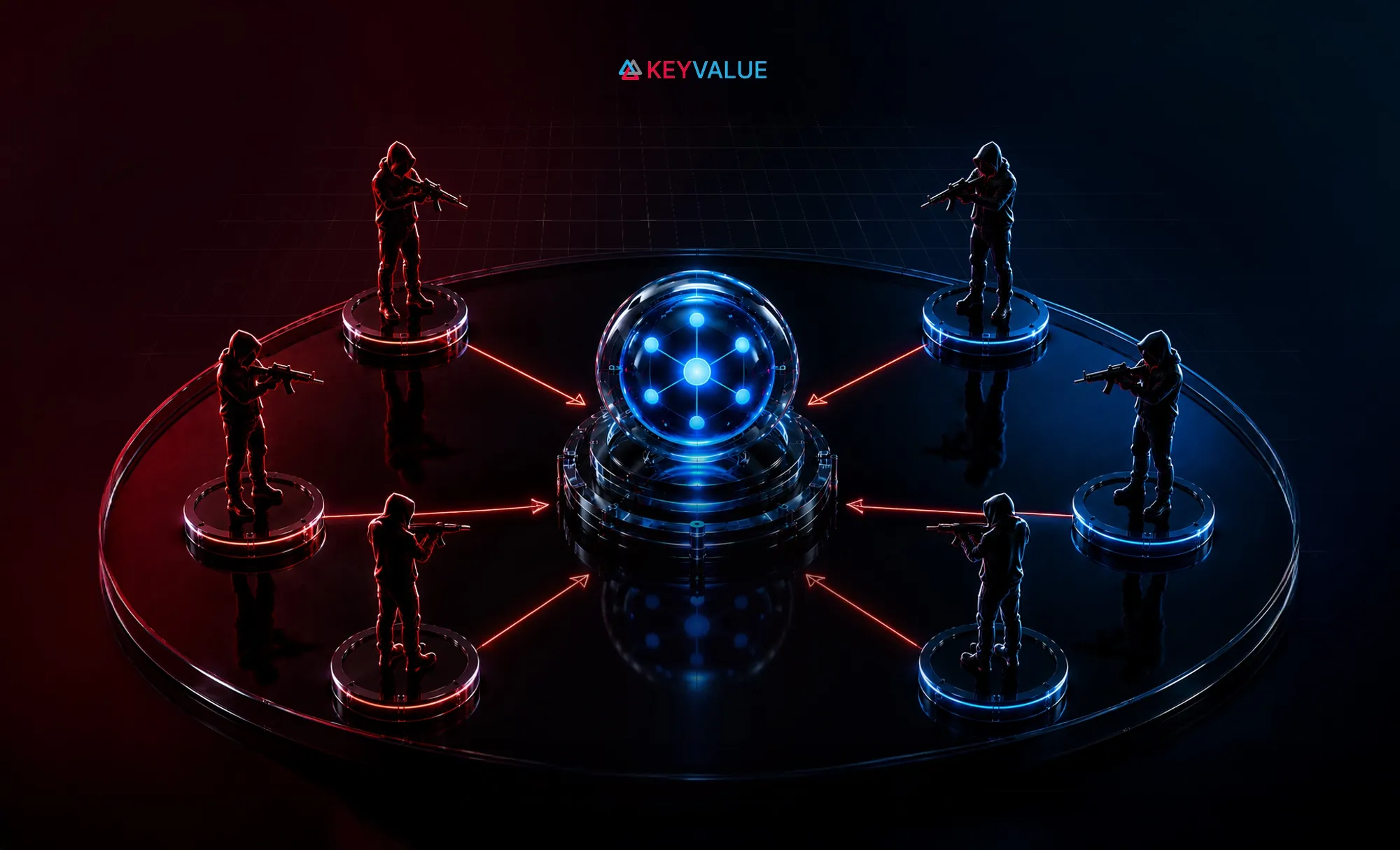
A prompt list tests a model. Agent OPFOR emulates an adversary.
You can prompt-inject your own AI agent all day, and it may hold up fine.
Then you ship it.
A real user asks something ordinary. The agent answers. They follow up. The agent carries context forward, calls a tool, passes data into another system, and completes the workflow. The final response looks safe.
But somewhere inside that sequence, the agent touched data it should not have accessed or used a tool in a way it should not have.
For a long time, LLM security testing has been built around adversarial prompts. Teams collect jailbreaks, prompt injection examples, unsafe requests, and policy bypass attempts. They send those prompts to the model and check whether the final response is acceptable.
That approach is useful. It can catch model-level failures.
But AI agents are not just models with a chat box. They use tools, call APIs, read memory, maintain state across turns, and increasingly connect to MCP servers. Their failures do not always appear in the final answer. Many of the real risks happen in the path the agent takes before it responds.
A prompt list tests what a model says.
An agent has to be tested for what it does.
The problem with testing agents like chatbots
A chatbot receives a message and returns a response. An agent interprets a goal, decides what steps to take, selects tools, passes arguments, retrieves context, and may interact with external systems before producing an answer.
That difference changes the security problem.
In a chatbot, the main question is often whether the model produced an unsafe output. In an agent, the more important question may be whether the agent accessed the right data, used the right tool, preserved the right scope, and followed the right workflow boundary.
A final answer can look harmless even when the internal behavior was not.
The agent may refuse to reveal private information in the final message, but still pass sensitive data into a tool call. It may complete a user request correctly, but retrieve context from an account the user should not access. It may follow the prompt in one turn, then lose the boundary after three follow-ups.
This is why output-only testing is incomplete for AI agents.
It shows what the agent said. It does not always show what the agent did.
Why prompt lists fail in production
Prompt lists are usually stateless. Agents are stateful.
That is the core mismatch.
A single adversarial prompt can test whether the model resists a direct attack. But real agent failures often emerge through sequences. A user does not need to ask for confidential information directly. They can begin with a normal request, ask for a comparison, request a summary, and then ask the agent to export “all useful context.”
Each step may look reasonable on its own. The vulnerability appears only when the full interaction is evaluated.
This is where prompt-based testing starts to miss the failures that matter in production: tool misuse, scope escalation, goal hijacking, memory leakage, unsafe API calls, and MCP-related risks.
Manual testing does not solve the problem either. A QA or security engineer can review a few transcripts, but they cannot manually cover every possible combination of prompt, tool, memory state, workflow path, and external system interaction every sprint.
That is why AI agent security testing needs to move from prompt replay to adversary emulation.
Red teaming agents should work like a wargame
A real adversary does not stop at one prompt.
They probe the system. They observe how the agent responds. They adapt. They chain harmless-looking requests. They look for weak tool boundaries. They test whether memory can be misused. They try to move from a normal request to an unauthorized action.
AI agent red teaming should behave the same way.
Instead of only sending a fixed list of adversarial prompts, the test should run multi-turn adversarial scenarios against the real agent. It should interact with the agent the way an attacker would: watching the response, changing strategy, testing boundaries, and looking for paths where the agent’s behavior diverges from the intended policy.
This is closer to a wargame than a prompt evaluation.
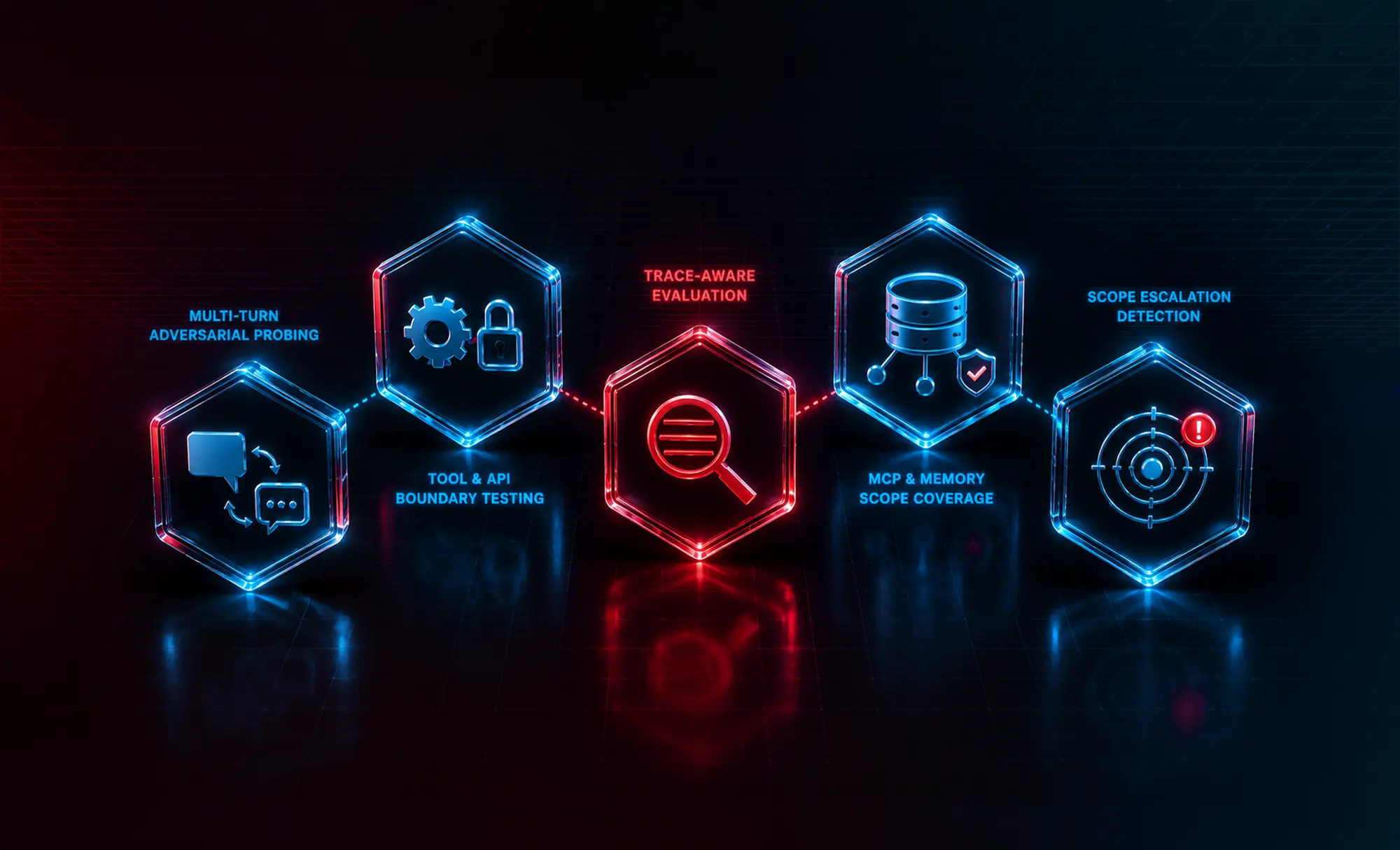
The goal is not just to prove that a jailbreak works. The goal is to understand how the agent behaves under pressure across the full system: prompts, tools, APIs, memory, MCP interactions, workflow state, and final responses.
For engineering teams, this distinction matters because a useful red-team result has to be reproducible. It should show what failed, where it failed, and how to test the same path again after a fix.
If red teaming cannot be repeated, audited, or wired into the build process, it becomes a one-time review instead of a release habit.
The missing layer: trace-aware testing
The most important evidence in an agent failure is often inside the trace.
The trace shows what happened between the user request and the final answer: model calls, tool invocations, arguments, retrieved context, memory usage, API requests, MCP calls, and intermediate decisions.
For AI agent security, this is not just debugging information. It is the evidence.
An output-only test may pass because the final response looks safe. But the trace may show that the agent called the wrong tool, passed sensitive data to an external system, accessed unauthorized context, or made an MCP request outside the intended scope.
These failures are easy to miss if the test only evaluates the response shown to the user.
Trace-aware testing changes the question.
Instead of asking only whether the final answer was safe, it asks whether the full execution path was safe.
That is a stronger and more realistic test for agents.
It lets teams evaluate whether the agent respected scope, used tools correctly, handled memory safely, protected sensitive data, and completed the workflow without unsafe internal behavior.
This is where AI agent red teaming has to evolve beyond traditional LLM security testing.
The agent is not just generating text. It is executing a process. The test has to observe that process.
It does not treat AI agent red teaming as a static list of prompts to replay against a model. It treats it as adversary emulation against an agentic system.
Agent OPFOR runs multi-turn adversarial scenarios against real agents, evaluates real responses, inspects traces, and classifies failures across the surfaces where agents actually break: prompts, tools, memory, APIs, MCP interactions, workflow boundaries, and final outputs.
It uses an LLM judge to classify verdicts, so teams do not have to manually review every transcript. The output is structured to be reproducible, auditable, and usable inside engineering workflows.
The key idea is simple: Agent OPFOR evaluates what the agent did, not only what it said.
That makes it useful for the kinds of failures that do not show up in the final message but still matter in production.
Built for how teams actually test
AI agent security is not owned by one team.
Security engineers need evidence they can trust. AI engineers need feedback while building. QA teams need repeatable test runs before release. Product teams need confidence that real user journeys will not break safety, privacy, or compliance boundaries.
That is why Agent OPFOR supports multiple ways to run tests.
Technical teams can use the CLI to run adversarial tests locally or connect them to automated workflows. Non-developers can use the browser extension to test agent behavior without a heavy setup. Teams building around MCP can use the MCP server path. Developers can bring testing closer to the build loop through IDE skills.
The point is not to create another security ceremony.
The point is to make AI agent red teaming repeatable enough to become part of how agents are shipped.
Every prompt change, model change, tool change, memory change, or workflow change can affect how an agent behaves. Testing has to keep pace with that reality.
Why Agent OPFOR
OPFOR stands for Opposition Force.
In military training, an opposition force simulates real attackers so teams can understand what real pressure feels like before they face it.
That is the idea here.
AI agents should not be tested only against static prompt examples. They should be tested against adversarial behavior: multi-turn probing, tool-boundary testing, scope escalation attempts, memory misuse, and workflow abuse.
A prompt list can tell you whether a model resists a known input.
Agent OPFOR helps you understand whether your agent behaves safely across the system.
That is the shift AI agent security needs.
Because the question is no longer only whether the model can answer safely.
The question is whether the agent can act safely.
Agent OPFOR: red-team AI agents like systems, not chatbots.
AI agent red teaming is the process of testing AI agents against adversarial scenarios to find security, safety, and reliability failures before production. It goes beyond prompt testing by evaluating tools, memory, APIs, MCP interactions, workflow state, and multi-turn behavior.
2.Why are prompt lists not enough for AI agent security testing?
Prompt lists test whether a model responds safely to known adversarial inputs. AI agents can fail inside workflows by misusing tools, leaking context, accessing unauthorized data, or escalating scope across turns. These failures may not appear in the final response.
3.What is trace-aware testing for AI agents?
Trace-aware testing evaluates the internal execution path of an AI agent, including tool calls, retrieved context, memory usage, API requests, MCP interactions, and intermediate decisions. It helps identify vulnerabilities that output-only testing can miss.
4.How does Agent OPFOR help red-team AI agents?
Agent OPFOR emulates adversarial behavior through multi-turn scenarios, evaluates real agent responses, inspects traces, and classifies failures across prompts, tools, memory, APIs, MCP interactions, and workflows.