Highlights
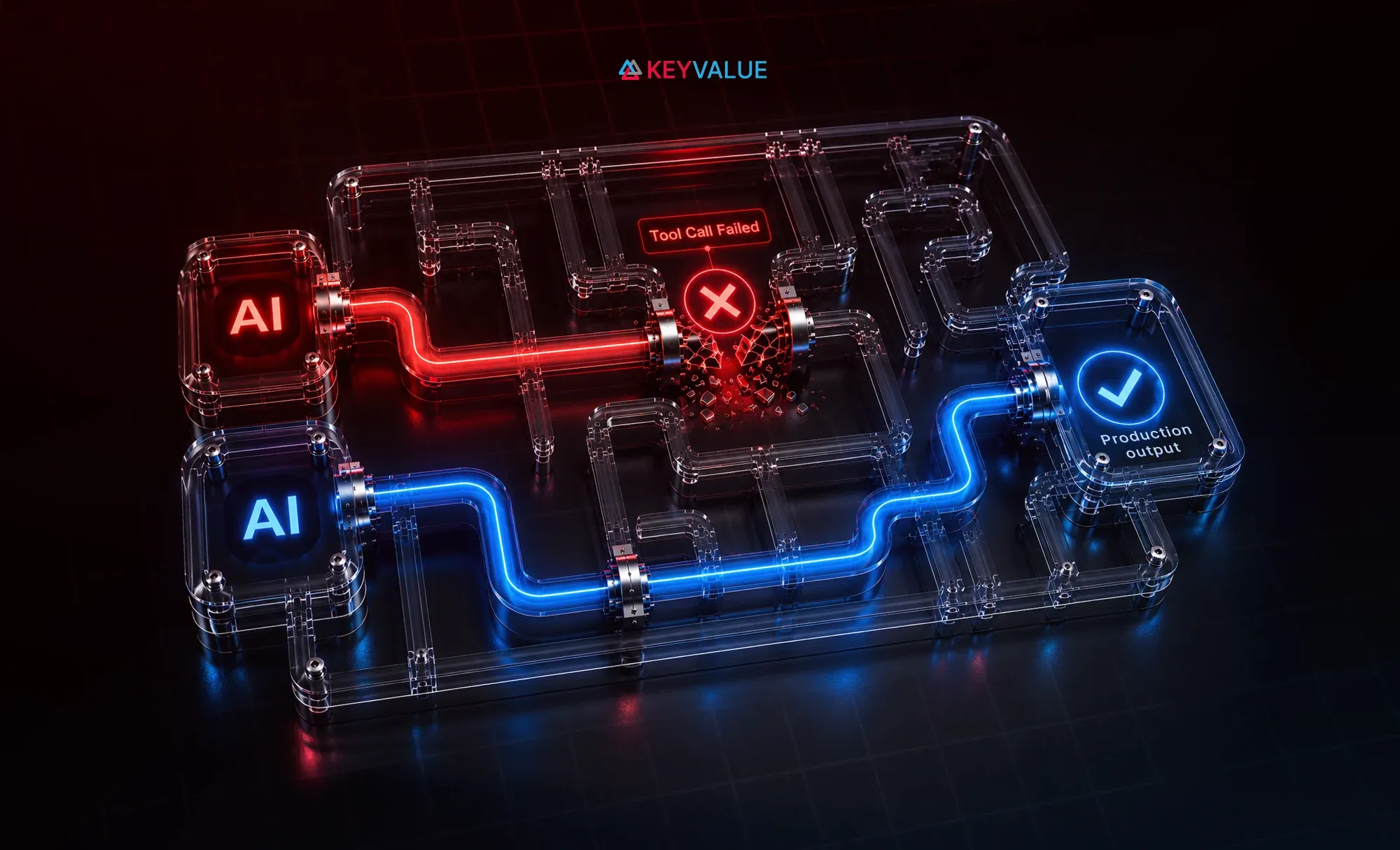
- Benchmark scores alone cannot determine the best LLM for an agent workflow, as reliability gaps compound across multi-step reasoning and tool execution.
- Large Language Model selection depends on task accuracy, tool-calling reliability, latency, cost per completed task, context handling, and consistency.
- Real-world evaluation and stress testing reveal how models perform across ambiguous queries, edge cases, adversarial inputs, tool failures, and changing traffic conditions.
- Netra makes LLM selection measurable through multi-turn simulations, A/B comparisons, production-trace evaluations, CI quality gates, and continuous monitoring.
You're three days away from your agent's production launch. You've shortlisted two models. Both pass your evals. Both handle your golden dataset cleanly. One costs twice as much per token, but scores marginally higher on the benchmark leaderboard. The other is faster, cheaper, and your gut says it's good enough.
Which one do you ship?
If your answer is "the one with the better benchmark score", you're solving the wrong problem. Benchmarks measure what a model can do in a lab. Agent workflows punish what it can't do under pressure. And in a multi-step agentic system, the gap between those two things is exactly where production failures live.
This is the model selection problem and most teams only discover they've solved it wrong after they've already shipped.
Why choosing the right LLM is different for agent workflows
Choosing an LLM for a simple chatbot is a relatively forgiving exercise. A wrong answer in a one-shot Q&A interaction is recoverable. The user rephrases, tries again, and moves on.
In an agentic system, an LLM doesn't just answer a single question. It reasons across multiple steps, calls external tools, manages context across a long conversation, makes decisions that feed into subsequent decisions, and often operates autonomously without a human in the loop. This changes the math of reliability in a fundamental way.
Consider a model that gets each individual step right 90% of the time. In a five-step workflow, the compound probability of a correct end-to-end result drops to just 59%. At ten steps, you're below 35%. In multi-step agent workflows, small reliability differences between models don't add; they multiply. A model that's 5% better at any single step can be the difference between an agent that works in production and one that fails nearly 4 in 10 times.
The same logic applies to latency, cost, and tool-calling accuracy. Every factor that looks acceptable in isolation can become a critical bottleneck at scale.
The benchmark trap
The natural starting point for model selection is benchmark data — AgentBench, GAIA, and task-specific evals like SWE-bench for coding agents. These scores are useful for forming a hypothesis. They're dangerous if treated as a decision.
But benchmark scores and real-world deployment performance measure different things. Benchmarks use clean inputs, predictable tool responses, and controlled environments. In production, your agent faces ambiguous user requests, flaky third-party APIs, rate limits, adversarial phrasing, unexpected data formats, and edge cases that no benchmark was designed to cover. Data contamination is also a real concern. Models trained on datasets that overlap with popular benchmarks will score well without that translating to genuine capability.
This doesn't mean benchmarks are useless. It means they're a starting filter, not a finishing criterion. You use benchmark data to narrow the candidate pool from dozens of models to three or four worth testing seriously. Everything after that has to be empirical.
The four factors that actually matter in production
Once you're beyond benchmarks, choosing the right Large Language Model for agent workflows comes down to four factors. And the right balance between them depends entirely on your specific use case.
1. Task accuracy and reasoning quality
Can the model reliably complete the tasks your agent is designed to perform? This includes multi-step reasoning, instruction following, tool call correctness, and handling ambiguous or adversarial inputs. For high-stakes agent decisions — anything where a wrong answer has real downstream consequences — this is the non-negotiable dimension. Frontier models from Anthropic, OpenAI, and Google generally lead on reasoning-heavy tasks, but better reasoning comes at higher latency and significantly higher per-token pricing.
2. Latency
For user-facing agents, latency is a UX-killer. For automated pipelines, it becomes a throughput constraint. Either way, it compounds across steps. A 2-second per-call difference between two models becomes a 20-second difference across a 10-step workflow. Always evaluate latency at the p95 and p99 percentiles, not just the average; tail latency is where user experience actually breaks down.
3. Cost
Beyond raw per-token pricing, the economic reality of LLM agents is more complex. Two agents achieving similar accuracy on the same task can differ by 50x in total cost — one making three focused LLM calls with precise tool use, the other making 40+ calls with redundant reasoning loops. Model selection isn't just about which model is cheapest per token; it's about which model achieves your task goals most efficiently. Strategic optimization — intelligent model routing, right-sizing models to subtasks, and reducing unnecessary inference calls — can reduce costs by 40-90% while maintaining or improving quality.
In agentic systems, the model isn't just generating text. It's parsing structured instructions, invoking external tools with correct parameters, and following complex multi-step instructions reliably. A model with a 95% success rate at tool calling becomes a liability in a workflow that chains eight tool invocations. Test this explicitly with the tools and schemas your agent actually uses, not with generic function-calling benchmarks.
The hidden variables: Context window and consistency
Beyond the four primary factors, two variables regularly derail model selection decisions in production.
Context window utilization matters not just in terms of maximum tokens, but in how the model performs as the context grows. Many models degrade significantly on tasks that require reasoning over content buried deep in a long context, a phenomenon called "lost in the middle." For RAG-heavy agents, document processing pipelines, or long-running multi-turn workflows, test your model's actual performance as the context grows, not just with short, clean inputs.
Consistency under repeated execution is another production-specific concern. The same prompt can produce different reasoning paths, tool sequences, and answers across multiple runs. For non-deterministic tasks, this variance is expected but its magnitude matters. A model that gives wildly inconsistent outputs on ambiguous queries is harder to evaluate, debug, and build trust in. Models with more deterministic instruction-following behavior are often preferable in orchestration-heavy systems even if a more creative model would score higher on a one-shot benchmark.
Why you can't choose the best LLM without stress testing
The most common mistake in Large Language Model selection is evaluating models only on their best-case behavior — curated test datasets, well-formed inputs, stable environments.
Production looks nothing like that.
Real users mix ambiguous queries with malformed inputs, ask the same question in ten different ways, probe edge cases unintentionally, and send traffic in bursts that expose rate limits you never anticipated. Models that sailed through your evaluation suite can throttle, hallucinate, or degrade under any of these conditions. A model selection process that doesn't account for this is optimizing for a world that doesn't exist.
This is where stress testing becomes the decisive step in choosing the best LLM. Rather than evaluating "does this model answer this question correctly?", stress testing asks: "does this model maintain acceptable performance when I systematically push it against the conditions it will actually face?" That means testing with realistic multi-turn conversations, with persona-driven users who behave unexpectedly, with adversarial inputs designed to expose failure modes, and with side-by-side comparisons that measure regression and improvement across concrete metrics — quality, cost, and latency simultaneously.
The output of a proper stress test isn't a pass/fail judgment. It's a quantified picture of where each candidate model holds up and where it breaks, which is exactly the information you need to make a confident selection.
A practical framework for LLM selection
A sound model selection process for agent workflows looks like this:
Start with requirements, not rankings. Define the failure cost of your use case before touching a benchmark. A wrong answer in a high-stakes financial or medical workflow demands a different threshold than a wrong answer in a low-stakes content generation pipeline. Map your tool integrations; the more complex the orchestration, the more you need a model with strong instruction-following and tool-calling reliability. Estimate your production volume, since above a certain scale, cost optimization can matter more than marginal quality gains.
Use benchmarks to shortlist, not select. Use public benchmark data to narrow from 10+ options to 3–4 candidates. Filter on the dimensions most relevant to your task type: reasoning benchmarks for logic-heavy workflows, function-calling evals for tool-intensive agents, context-length benchmarks for long-document pipelines.
Evaluate against your actual tasks. Build a representative evaluation dataset from your real use cases. Run each candidate model against it. Measure task success rate, tool call correctness, output quality, latency (at p50, p95, p99), and cost per completed task.
Stress test before committing. Simulate the range of conditions your agent will face in production — varied user personas, edge case inputs, adversarial phrasings, high-load scenarios. Compare models side by side under these conditions. The model that wins here is the right LLM to deploy.
Monitor continuously in production. Model selection isn't a one-time decision. Providers silently update models, your traffic distribution shifts, your agent's prompt evolves; all of these can alter which model is optimal. So treat evaluation and monitoring as a continuous production practice.
Following this framework manually is feasible at a small scale. At production scale — with multiple agents, multiple model candidates, evolving prompts, and real user traffic — the tool you use to evaluate and stress test models becomes as important as the models themselves.
Netra, our AI observability, evaluation, and simulation platform is built specifically for teams operating AI agents in production. It gives them the data they actually need to make model selection decisions; not benchmark scores, but real behavior under real conditions.
For model selection specifically, Netra's Simulation feature is the most direct tool. It lets you run full multi-turn conversational simulations against your agent with configurable user personas — neutral, friendly, frustrated, confused, or custom — before any real user ever interacts with it. You set a scenario goal, define the user's behavioral profile, specify facts the agent must communicate correctly, and run the simulation end to end. The result is a detailed view of how your agent actually performs across a range of realistic conditions. Netra provides seven pre-built multi-turn evaluators — goal fulfillment, information elicitation, guideline adherence, conversation completeness, conversational flow, conversation memory, and factual accuracy — which you can add to your simulation flow to score the conversation.
The A/B comparison capability takes this further. You can run production traces from an existing agent configuration against a new model or prompt change and get a direct diff across quality, cost, and regression metrics — turning 'should we switch to this model?' from a judgment call into a data-backed decision.
Beyond simulation, Netra's Evaluation layer lets you build datasets from your real production traces — capturing the ambiguous, messy, real-world inputs your users actually send — and run systematic test runs against any model or prompt change before it reaches production. CI gate integration means a model downgrade that quietly regresses quality can never silently ship.
For ongoing production monitoring, Netra traces every LLM call, tool execution, and decision path in real time, tracking latency at p50/p95/p99, token usage, and cost per request. If a model update changes your agent's behavior, even without a single line of your code changing, Netra's Agent Insights layer detects the drift automatically and surfaces it in a daily plain-English brief.
The practical result: teams using Netra to inform model selection and monitor production performance have reported up to 94-96% reduction in mean time to resolution for agent incidents, and 70-75% reduction in AI infrastructure costs.
Getting LLM selection right
Choosing the best LLM for agent workflows is one of the decisions that looks simple from the outside and turns out to be one of the most consequential you'll make. The right LLM isn't the one with the highest benchmark score, or the cheapest per token, or the fastest to respond. It's the one that performs reliably across the full range of conditions your agent will face in production, at a cost and latency profile that makes the system economically viable.
Getting there requires moving past benchmarks to empirical evaluation, building realistic test datasets from your actual use cases, stress testing against the messy reality of production traffic, and monitoring continuously so that model selection becomes an ongoing practice rather than a one-time call.
For engineers building AI agents, the investment in doing this rigorously pays back quickly — in agents that actually work, costs that stay predictable, and the ability to ship improvements with confidence rather than anxiety.
Explore how Netra turns model selection into a data-backed decision and helps you ship with confidence: getnetra.ai
FAQ
1. How do you choose the best LLM for an agent workflow?
The best LLM is the one that completes your agent’s real tasks reliably while meeting your accuracy, latency, cost, and tool-calling requirements. The model with the highest benchmark score is not always the best production choice.
2. Why are benchmark scores not enough for LLM selection?
Benchmarks measure performance in controlled environments and may not reflect ambiguous requests, API failures, rate limits, adversarial prompts, or unexpected data formats. They are useful for shortlisting models, but not for making the final decision.
3. What factors should be considered when comparing LLMs for AI agents?
The main factors are task accuracy, reasoning quality, tool-calling reliability, latency, and cost per completed task. Context performance and consistency across repeated runs should also be evaluated.
4. Why is stress testing important when selecting an LLM?
Stress testing shows how a model performs under realistic conditions such as multi-turn conversations, ambiguous inputs, edge cases, adversarial prompts, tool failures, and high traffic.
5. Should LLM cost be measured by token price?
Not by token price alone. Teams should measure the total cost per completed task, including token usage, the number of model calls, repeated reasoning loops, and tool interactions required to produce a successful result.
6. How does Netra support LLM selection?
Netra supports multi-turn simulations, A/B comparisons, production-trace evaluations, CI gates, and continuous monitoring. This helps teams compare model quality, cost, latency, and regressions using production-relevant data.