Highlights
- The interface is losing its role as the primary product experience. AI agents are moving users from navigating software to delegating outcomes.
- APIs are becoming the new product surface. Agents will judge products on structured data, reliability, pricing clarity, and execution, not visual UX alone.
- Discoverability is shifting from ranking to selection. The key question will increasingly be whether an AI agent chooses your product at all.
- Product teams must design for two audiences: humans and agents. Human trust and machine readability will both determine who wins.
The interface is no longer the product
For the last two decades, the internet has been designed around interfaces. Every product decision from landing pages to checkout flows has been about optimizing how users click, navigate, and convert. The entire digital economy has been built on the assumption that users interact directly with software.
That assumption is starting to break.
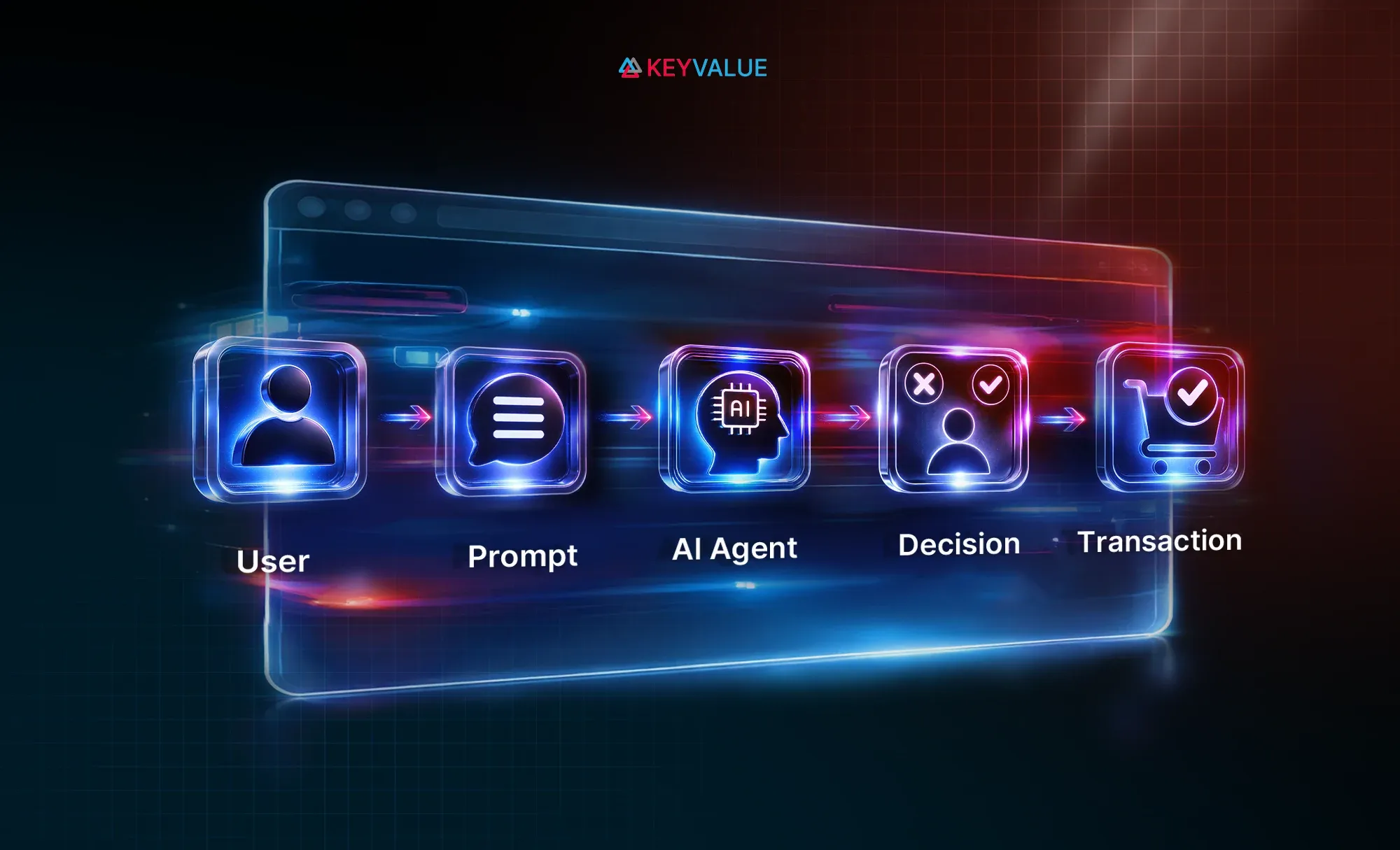
With the rise of AI agents that can understand intent, reason through tasks, and execute actions, the interface is no longer the primary point of interaction. Users are beginning to delegate outcomes rather than navigate experiences. Instead of browsing, comparing, and deciding, they are simply stating what they want.
From interaction to delegation
Consider a simple instruction: “Find me a flight to San Francisco under $400, near Union Square, and include a hotel with free cancellation.” In the traditional model, this would require multiple platforms, dozens of comparisons, and significant user effort.
In the agent-driven model, the workflow collapses into a single action. The agent searches, evaluates, and transacts often without exposing the user to any interface at all.
This is not just a UX improvement. It is a structural shift in how products are discovered and consumed.
AI agents as a new abstraction layer
AI agents are not just more capable chatbots; they represent a new abstraction layer over software. They combine natural language understanding, planning systems, and execution layers that interact directly with APIs.
From the user’s perspective, complexity disappears. From a product perspective, something more profound happens: the user no longer experiences your product, they experience the outcome your product delivers.
The collapse of the user journey
As this layer matures, the traditional user journey begins to collapse. The familiar funnel awareness -> consideration -> evaluation -> conversion assumes that users explore options and make decisions themselves.
AI agents compress this entire journey into a single step: intent to decision.
The exploration phase disappears, and with it, the opportunity for most products to even be considered.
This creates a new kind of competitive dynamic. In a world where agents surface one or two recommendations, visibility is no longer about ranking; it’s about selection. If your product is not chosen by the agent, it effectively does not exist in the user’s journey.
APIs are the new UI
When agents interact with products, they don’t see design systems, onboarding flows, or visual polish. They evaluate structured data, reliability signals, and execution capabilities.
Your API response time matters more than your page load speed. Your data clarity matters more than your copywriting. Your uptime, pricing transparency, and integration depth become the signals that determine whether an agent trusts you enough to act on behalf of a user.
In this context, the API is no longer a backend concern; it is the product surface. It is how your product is understood, evaluated, and used.
Rethinking distribution and growth
This shift also rewrites how distribution works. Historically, growth has been driven by search rankings, paid acquisition, and app store visibility.
In an agent-first world, distribution will increasingly depend on trust within agent ecosystems. Products that are easy to integrate, predictable to execute, and clear in their outcomes will be preferred not because users click them, but because agents select them.
Alongside this, the metrics that matter will evolve. Traffic, click-through rates, and even traditional conversions will become less informative. Instead, product teams will need to understand how often they are recommended by AI systems, how frequently transactions are initiated by agents, and how their product performs within automated decision loops.
Visibility will shift from being measured in impressions to being measured in inclusion.
Your customer has changed
Perhaps the most subtle but important change is this: your customer is no longer just the end user. It is also the AI agent acting on their behalf.
This dual audience forces a new kind of product thinking, one that balances human trust with machine readability. Products must now be designed to be both intuitively valuable to people and structurally legible to systems.
If you ignore either, you lose.
What you can do now
For product leaders, this raises an immediate question: What should you do now?
The first step is awareness. Ask leading AI systems about your category and observe whether your product appears. If it doesn’t, you are already losing visibility in emerging decision layers.
The second step is to elevate your API from infrastructure to strategy. It should be reliable, well-documented, and designed as a primary interface, not a secondary one.
The third is to rethink your approach to discoverability. Optimizing for search engines is no longer sufficient; you must ensure your product is understandable and selectable by AI systems.
Equally important is aligning product, marketing, and data. In an agent-driven world, positioning is no longer just messaging; it is encoded in how your data is structured, how your capabilities are exposed, and how consistently your product behaves.
Finally, trust becomes non-negotiable. Transparent pricing, predictable outcomes, and strong operational reliability are no longer differentiators; they are prerequisites for being chosen.
The new gatekeepers of the internet
We are entering a phase where AI agents act as the decision-making layer of the internet. This is not just another interface shift like mobile or web; it is a shift in who, or what, makes the decision.
The companies that succeed will not necessarily be the ones with the most beautiful interfaces. They will be the ones whose systems are easiest for agents to understand, trust, and execute.
Because in the near future, users won’t always choose your product.
But an AI will.
At KeyValue, we work with product teams to design and build agent-ready systems from API-first architectures and scalable platforms to AI-driven product experiences that are built for the next generation of interaction.
If you’re looking to future-proof your product and stay discoverable in an agent-first world, let’s talk.
FAQs
1. What does API mean?
API stands for Application Programming Interface. It’s a defined way for one software system to communicate with another, request data or functionality, and receive a response. In simple terms, APIs allow different applications and systems to work together without needing to know how each other is built internally.
2. What are APIs used for?
APIs are used to connect software systems and enable them to exchange data or perform actions. For example, an API can allow an application to retrieve location information, process a payment, access another platform's data, or trigger functionality in an external service.
3. Is ChatGPT an API?
No. ChatGPT is an application, while the OpenAI API is a developer platform that allows businesses and developers to integrate OpenAI models and capabilities into their own products and services. OpenAI treats ChatGPT and its API platform as separate products.
4. Why are APIs important for AI agents?
APIs give AI agents structured ways to interact with software. Instead of navigating every product through a visual interface, an agent can use available APIs to retrieve information, execute supported actions, and connect multiple systems as part of a workflow. OpenAI's developer platform, for example, supports building agents that can take actions on behalf of users.
5. Are APIs replacing user interfaces?
Not entirely. Human-facing interfaces will continue to matter, especially when users want to explore, review, customize, or make sensitive decisions. But as AI agents handle more tasks on users' behalf, APIs and other machine-accessible product surfaces may become increasingly important alongside traditional interfaces.