Choosing from a long list of outsourced product development companies can seem simple at first.
Most companies will have similar promises to make. Experienced engineers, agile delivery, flexible teams, faster launches, and cost efficiency are a few of them. But are these enough when you are building a real product, especially one that has to scale, adapt, and compete in a fast-moving market?
What sets a product development company apart from the rest is not just technical capability. It is how the team thinks, collaborates, takes ownership, uses AI, understands your domain, and responds when uncertainty shows up.
The best outsourced product development companies do not operate like external execution teams. They work like true product partners. They challenge weak assumptions, understand users, bring technical judgment, use AI meaningfully, and stay accountable beyond the codebase.
This is what separates a basic development company from a product development partnership that can actually create long-term value.
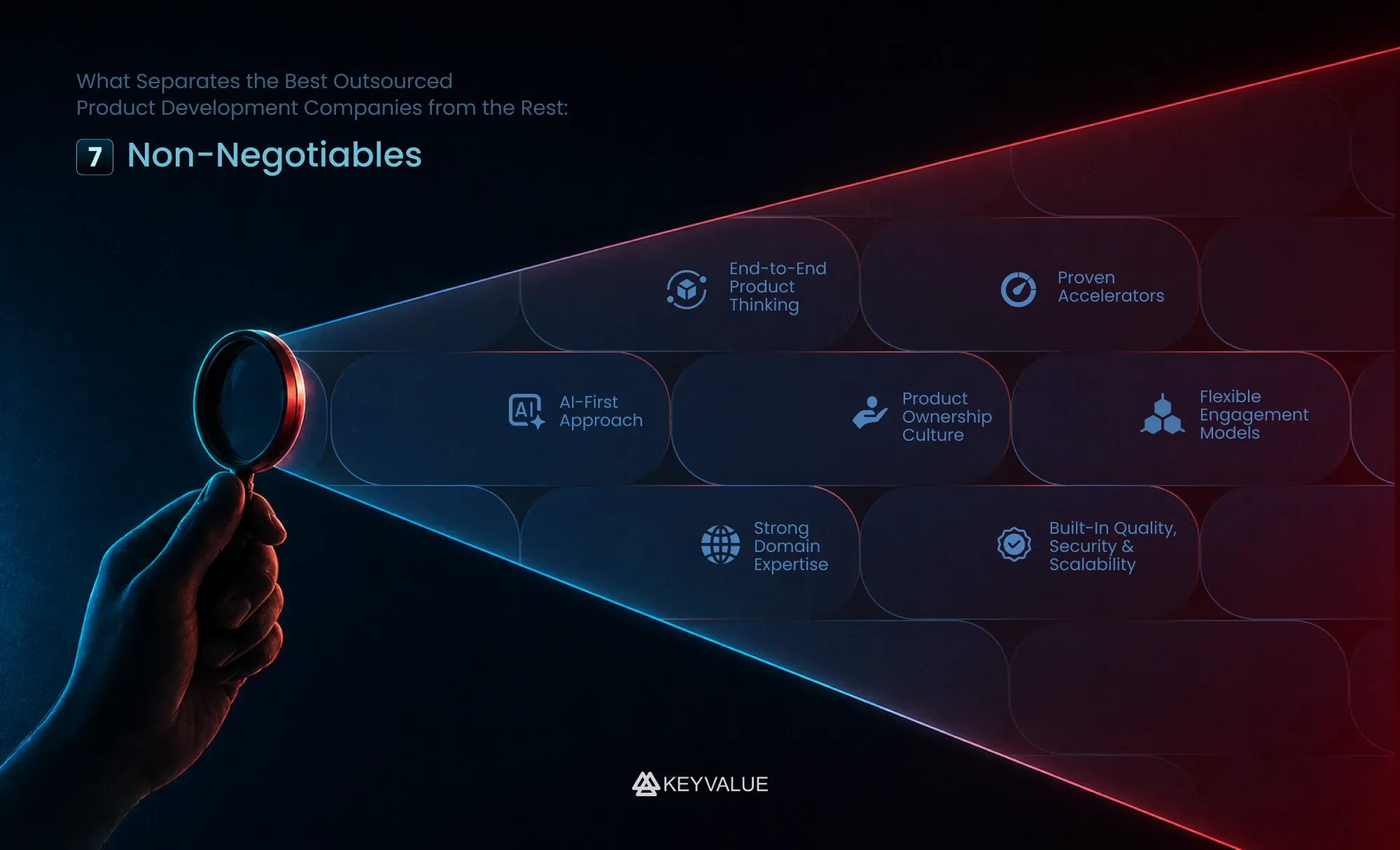
Here are the seven non-negotiables to look for when choosing the right outsourced product development company.
1. An AI-first approach, not AI as an add-on
AI is no longer a feature that can be looped in toward the end of product development. It is now shaping how products are imagined, designed, engineered, tested, deployed, and improved.
That is why the best outsourced product development companies do not treat AI as a trend. They treat it as the core product and engineering advantage.
A strong product development partner should utilize AI in two ways. First, the team should be proficient to build AI-powered products and intelligent workflows for clients. This could include generative AI, conversational AI, AI agents, recommendation systems, predictive analytics, computer vision, document intelligence, personalization engines, and LLM-powered workflows.
Second, the team should use AI inside its own development process. AI-assisted coding, test generation, documentation, prototyping, DevOps automation, quality checks, and workflow acceleration can all improve how fast and effectively a product team works.
This distinction matters. A company that only experiments with AI tools is very different from an AI-first product development partner that knows how to apply AI across the product lifecycle.
For startups and scale-ups, this can create a major advantage. AI-first product development helps teams proceed faster, reduce manual effort, improve product intelligence, and make the right decisions during development. It also ensures that AI is not treated as a disconnected feature. Instead, it becomes part of the way the product is mapped out, built, tested, and improved.
The strongest outsourced product development companies understand that AI is not just about adding a chatbot or connecting an API. It is about reimagining how the product works, how users interact with it, how internal workflows run, and how the product can keep improving over time.
2. End-to-end product thinking
Many companies can build features. Far fewer can build products.
That is one of the most important differences to understand when evaluating outsourced product development companies. A feature-focused team waits for instructions. A product-focused team understands the larger goal, identifies gaps, and helps turn uncertainty into clear product decisions.
End-to-end product thinking covers the full journey from discovery to launch and beyond. It includes product strategy, user experience, architecture, engineering, quality assurance, security, analytics, scaling, and continuous improvement.
This is important since code is rarely the only factor that determines a product's success. If the roadmap is unclear, the architecture cannot scale, the user experience is poor, or the team creates too much before properly verifying it, a technically sound product may nonetheless fail.
The best outsourced product development company will not simply ask what needs to be built. It will try to understand why the product needs to exist, who it is for, what business outcome it should create, and what needs to be validated first.
That mindset helps prevent bloated products that look complete but fail to create real value.
Strong product development partners bring structure into ambiguity. They help founders and business teams make better trade-offs. They know when to build, when to simplify, when to validate, and when to push back on an idea that may not support the product’s larger goal.
This is especially important for early-stage products. At that stage, the goal is not just to ship quickly. The goal is to learn quickly, build the right foundation, and avoid decisions that create expensive rework later.
The best outsourced product development companies do not stop at delivery. They help shape what the product can become.
3. Domain depth that improves product decisions
Domain depth is more than just a desirable feature. It directly affects product quality.
A team that understands tech across sectors like Fintech, edtech, healthtech, retail, hospitality, cybersecurity, enterprise SaaS, logistics, or AI workflow tools can make stronger product decisions faster. They know the common integration patterns, compliance concerns, user expectations, operational risks, and failure points within that category.
Without domain depth, a team may still build technically correct software. But technically correct does not always mean useful, scalable, or market-ready.
For example, a fintech product may need strong attention to security, compliance, transaction flows, audit trails, and user trust. A healthcare workflow product may need privacy-first architecture, careful access control, and reliability across multiple user roles. An enterprise SaaS platform may need strong admin controls, reporting, integrations, and role-based workflows from an early stage.
When an outsourced product development company has worked across similar product categories, it brings more than engineering capacity. It brings pattern recognition.
That experience helps the team ask better questions, spot risks earlier, and avoid decisions that may look efficient in the short term but create problems later.
This is why founders should look beyond portfolio screenshots or broad industry claims. The real question is whether the company understands the kind of complexity your product will face.
A strong product development partner can explain trade-offs clearly. Their experience helps them identify domain-specific risks before they become blockers. It can bring reusable insight from similar products without forcing your product into a generic template.
Great product development is not only about writing code. It is about making the right decisions with the right context.
4. A product ownership culture
Ownership is one of the clearest signals that you are working with a true product partner.
A team with ownership does not hide behind a checklist of completed tickets. It cares about whether the product works, whether users adopt it, whether performance holds under pressure, and whether each release supports the business goal.
This mindset changes how the team behaves every day.
Ownership-driven teams flag risks early. They question ambiguous decisions. They suggest better alternatives. They think beyond assigned tasks. They care about usability, performance, reliability, and long-term maintainability.
This is where many outsourced product development engagements either succeed or fail.
A task-based team may deliver exactly what was requested, even if the request is flawed. A product ownership team will tell you when the request itself needs to change.
That difference matters because product development is full of uncertainty. Requirements change. User feedback creates new priorities. Technical risks appear. Market timing shifts. A team that only follows instructions can keep moving, but not always in the right direction.
The best outsourced product development companies protect the product, not just the plan.
They are willing to challenge assumptions when needed. They take responsibility for outcomes, not just output. They understand that shipping software is only one part of the job. Building something useful, stable, and valuable is the real goal.
For startups, this ownership culture can be especially valuable. Founders do not just need more hands. They need a team that thinks with them, moves with urgency, and brings clarity when decisions are messy.
5. Proven accelerators, not just promises of speed
Every outsourced product development company promises speed. But speed alone is not enough.
Fast development without the right structure can create fragile products. It may help a team launch sooner, but it can also lead to weak architecture, poor documentation, inconsistent quality, and technical debt that slows the product down later.
The best product development partners accelerate intelligently.
They use reusable components, internal frameworks, design systems, DevOps templates, QA automation, security practices, and product playbooks to reduce repetitive work. This allows the team to spend more time on what is unique to the product instead of rebuilding basic foundations from scratch.
These accelerators may include authentication modules, role-based access components, reusable UI systems, testing frameworks, deployment pipelines, admin dashboards, notification systems, analytics foundations, and AI workflow templates.
The value of accelerators is not just speed. They also improve consistency and reduce risk. When common product foundations are already tested and refined, teams can move faster without weakening quality.
But there is an important balance.
The best outsourced product development companies know when to reuse and when to customize. They do not force every product into the same structure. A marketplace, a B2B SaaS platform, a fintech workflow, and an AI-powered internal tool will all need different architectural decisions.
Good accelerators support the product. They do not define it.
That is what separates intelligent acceleration from rushed development. One creates momentum. The other creates rework.
6. Flexible engagement without fragmented accountability
Not every product needs the same kind of team from day one.
Some founders need help shaping an idea and building an MVP. Some growing companies need expertise in architecture, QA, DevOps, cloud, or AI. Some teams need a complete product pod. Others need specialist support that works alongside an internal engineering team.
Strong outsourced product development companies offer flexible engagement models without losing accountability.
That last part is important.
Flexibility works well until every process starts moving in a different direction. If product strategy, design, engineering, testing, and deployment feel disconnected, the product suffers. Context gets lost. Communication slows down. Decisions become reactive. Quality becomes inconsistent.
The best product development partners know how to scale their teams up or down while preserving a single product vision, shared context, and clear ownership.
This is why end-to-end capability matters. It gives the partner enough range to support the product as needs evolve. A company may start with MVP development, then need AI integration, platform modernization, cloud migration, performance optimization, or long-term product evolution.
When these capabilities are connected, the product moves with more continuity. The team does not have to restart context at every stage. Decisions made during early development can support what comes later.
For founders, the goal is not just to find a flexible team. It is to find a product development partner that can adapt without losing ownership.
The right partner should make growth feel more structured and organized, not more complicated.
7. Quality, security, and scalability built into the process
The best outsourced product development companies do not treat quality as a final checkpoint.
They build it into the operating system of the team.
That means clean architecture, code reviews, automated testing, secure development practices, performance monitoring, documentation, release discipline, and post-launch observability are not afterthoughts. They are part of how the product is built from the beginning.
This matters because speed without quality can become expensive. A product may reach the market fast, but if it cannot handle usage, protect data, support new features, or recover from failures, the cost of fixing it later can be much higher than building it properly in the first place.
A strong product development partner thinks about scale early. It considers how the system will behave when usage grows, where failures may happen, what data needs protection, what should be monitored, and what level of technical debt is acceptable.
This is even more important for AI-first products.
In AI-enabled products, quality is not only about uptime or performance. It also includes model behavior, hallucination risks, data privacy, response accuracy, drift, cost control, explainability, and user trust.
A team that understands AI-first product development will know that intelligent systems need continuous evaluation. AI outputs need to be tested, monitored, and improved. The product should not only work in ideal conditions. It should behave reliably in real-world usage.
That is why quality, security, and scalability cannot be separated from product development.
The best teams know that great products are not only shipped. They are maintained, measured, improved, and scaled.
How to choose the right outsourced product development company?
Choosing the right outsourced product development company should not come down to hourly rates, team size, or a polished portfolio alone.
Those details matter, but they do not tell the full story.
The better question is: how does this company think?
A strong product development partner should understand the business goal behind the product. It should be able to challenge assumptions, bring domain insight, support the full product lifecycle, use AI meaningfully, and take ownership beyond assigned tasks.
It should also have the engineering depth to build for quality, security, and scalability from the beginning.
When you evaluate outsourced product development companies, look for evidence of how they work, not just what they claim. Review their case studies, product outcomes, technical depth, communication style, AI capability, domain experience, and ability to support products as they grow.
The best outsourced product development companies are not just faster builders. They are better product thinkers.
They combine engineering depth, AI-first capability, product judgment, domain understanding, delivery intelligence, and ownership culture. That combination is what turns outsourced product development from a cost-saving decision into a growth advantage.
Final thoughts
Outsourced product development has evolved.
It is no longer only about reducing cost or accessing engineering talent. The new benchmark is value creation.
The best outsourced product development companies bring AI-first thinking, domain depth, end-to-end capability, product ownership, delivery intelligence, and long-term accountability.
The right partner should help you build faster. But more importantly, it should help you build smarter.
Because in a market where many teams can ship software, the real advantage is building products that users trust, adopt, and keep coming back to.
FAQs
What are outsourced product development companies?
Outsourced product development companies are external product engineering partners that help businesses design, build, test, launch, and scale software products. The best ones support the full product lifecycle, including strategy, UX, engineering, AI integration, DevOps, QA, security, and continuous improvement.
What makes the best outsourced product development companies different?
The best outsourced product development companies combine AI-first engineering, domain expertise, end-to-end product thinking, ownership culture, flexible engagement models, proven accelerators, and strong quality practices. They act as product partners, not just coding teams.
Why is an AI-first approach important in product development?
An AI-first approach helps product teams move faster, automate repetitive workflows, improve decision-making, personalize user experiences, and build smarter products. It also improves internal delivery through AI-powered coding, testing, DevOps, documentation, and design support.
How do I choose the right outsourced product development partner?
Choose a partner based on product thinking, relevant domain experience, technical depth, AI capability, ownership mindset, quality practices, communication, and ability to support your product as it grows. Avoid choosing based only on cost or team size.
Is outsourced product development only for startups?
No. Startups, scale-ups, and enterprises use outsourced product development companies to access specialized expertise, accelerate product delivery, modernize platforms, build AI capabilities, and scale engineering capacity without losing focus on core business goals.
What is the difference between outsourcing and a product development partnership?
Traditional outsourcing often focuses on completing assigned tasks. A product development partnership is more strategic. It involves shared ownership, product thinking, technical decision-making, roadmap support, and long-term accountability for outcomes.